KA: Capability and the Flame Within

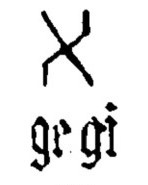
Last night I turned my attention to the Rune KA in advance of a class I was to conduct. In a wave of understanding I came to appreciate that beyond the physical or even the intellectual, that KA symbolizes the divine spirit within - bestowed by the Gods themselves-- a concept that crosses cultures, religions, and time itself. "Torch is known to each living being by fire." (OERP)
Written on 21 and 22 July 2026.
*********
The KA Rune represents capability—the innate power to think, create, and become. It signifies not only intellectual capacity but also the living spirit that animates the human being. Like a torch, KA symbolizes the flame within: the light of consciousness, wisdom, inspiration, and life itself. In the Norse creation myth, Odin and his brothers find Askr and Embla as lifeless pieces of driftwood upon the shore. Though they possess form, they lack the animating principle of life. Snorri writes in Gylfaginning,
“As Bor’s sons walked along the sea shore, they came across two logs and created people out of them. The first gave breath and life, the second consciousness and movement, the third a face, speech and hearing and sight.”(1)
Odin breathes óðr into them—the divine spirit, inspiration, and vital force that transforms a body into a living human being. This sacred breath bears striking similarities to the concept of prāṇa in the Indian traditions: the vital life-force carried upon the breath. One might even see this reflected symbolically in Odin's name itself—Od-in—the spirit within. Just as a flame cannot exist without air, the inner torch of the human spirit cannot burn without breath. The body alone is merely matter, but when infused with divine life-force it becomes a conscious being capable of wisdom, creativity, and purposeful action. Thus, KA represents capability in its fullest sense: the power to know, to create, to transform, and ultimately to procreate, carrying life forward into future generations.
The torch has long served as one of humanity's oldest symbols of this inner reality. Across religious, philosophical, and esoteric traditions, it represents far more than physical illumination. It is the visible emblem of the divine spark dwelling within every person.
Among the Greeks, philosophers described the soul as participating in an eternal light, while the Stoics taught that each individual possesses a portion of the divine logos—a fiery principle of reason permeating the cosmos. In Christianity, fire is one of the foremost biblical symbols of the Holy Spirit, and the torch serves as a natural extension of that symbolism. John the Baptist, referring to Christ says, “He will baptize you with the Holy Spirit and fire.”(2) Many mystical traditions likewise speak of the spirit as an inner flame. Unlike a candle, however, a torch is meant to be carried. It symbolizes not merely possessing the light, but actively bringing it into the world through wisdom, courage, and enlightened action. The torch also signifies awakened consciousness. It reveals what darkness conceals, overcoming ignorance, forgetfulness, and spiritual sleep with insight, self-knowledge, and initiation. In this sense, the torch is the outward manifestation of the inner awakening that every seeker strives to attain.
Although torches themselves are rare in surviving Norse symbolism, fire remains intimately connected with óðr—inspiration, living breath, ecstatic consciousness, and sacred knowledge. Odin's sacrifice upon Yggdrasil and his discovery of the runes can be understood as the journey of one who carries the inner torch into the darkness and returns illuminated. The Rune Master likewise awakens this hidden fire within, becoming not merely one who possesses knowledge, but one who embodies living wisdom.
An intriguing parallel may also be found in ancient Egypt. The Egyptian Ka was understood as a person's vital essence or life-force—the invisible power that distinguished a living human from an inanimate body. The Ka is best understood as the animating power that makes a human being alive while also serving as an enduring spiritual counterpart that survives after death. This idea bears an interesting resemblance to the Genesis account in which Adam's body exists before God breathes into him "the breath of life," and to the Norse account in which Askr and Embla remain lifeless wood until Odin bestows óðr. In each case, the body alone is incomplete until enlivened by a divine principle. While there is no established historical or linguistic connection between the Egyptian Ka and the Germanic KA Rune, both express a remarkably similar intuition: that true humanity begins when the divine life-force ignites the flame within.
Across traditions, the torch represents more than physical light. It is the visible sign of the invisible spirit. Whether understood as Odin's óðr, the Egyptian Ka, the Greek logos, the Indian prāṇa, or the Holy Spirit of Christianity, the inner flame symbolizes the divine life-force that transforms inert matter into a living, conscious, creative human being. In this sense, the KA Rune is the torch of capability—the awakened divine spirit carried into the world.
Notes:
1. Snorri Sturluson, Edda, Anthony Faulkes, trans. (North Clarendon, VT: Everyman, 1995), 13.
2. Matthew 3:11.


Comments
Post a Comment