Posts

Showing posts with the label Guido von List

Armanism and Wuotanism

Image
Written on eve of the anniversary of Grandmaster List's passing away to his new arising-- 16/17 May 2025.  Conceived for many days, weeks, months, and years. List wrote of the rune MAN --"Be a Man!" We must ultimately reveal true self. Be true to thine self. If not now, then when? ********* To the vast majority, the terms “Armanism” and “Wuotanism” are unknown and obscure— words hardly a part of the popular vocabulary. For those familiar with contemporary Heathenism or occultism the terms may conjure up imprecise and inaccurate ideas supercharged with polemics and politics. While some might, and have, argued that these terms reach back into antiquity, their popularization and perhaps even origin date to the early 20th century and the ideas and works of the Austrian mystic, Guido von List (1848-1919).  Today, List is identified by his supporters and detractors alike as an early proponent of Heathenry or Odinism and the creator of an odd, if not discredited, rune-row or Fut...

List’s Secret Armanen Wisdom

Image
Over the past several weeks, I have further explored the ideas of Guido von List. My initial draft is completed on this, the 17th day of November 2024.  ********* An important, but often overlooked, concept in Guido von List’s Das Geheimnis der Runen ( The Secret of the Runes )[1] is that the ancient Armanen (the societal class comprised of priests, skalds, magicians, and kings) concealed key philosophical principles within the mysterious symbols known as Runes and the Eddic passages they wrote to describe them. List reveals several layers of secrets of the Runes in his most famous volume. First, he recognizes the 18 verses of the Hávamál referred to as the Rúnatal or Odin’s Rune Song corresponded to an 18 Rune Futhorkh. The next secret has to do with the interpretation of the meaning of these ancient symbols. To provide that, List takes the approach of interpreting the known Rune Poems,[2] the relevant Hávamál verses, and the etymological roots of words extending their German ...

Gematria and the Armanen Runes

Image
Rudolf John Gorsleben commented,"The Runes are symbols of the pulsating life, they are life itself, reduced to a mathematical formula. They are in some mystical relation to the law of the numbers as the basis of all cosmic and philosophical thinking." There is undoubtedly more to be said of this topic. Revised 19-10-24. ********* Gematria is the magickal practice of assigning a numerical value to a name, word, phrase, or letter and associating it with a number. While the word “Gematria” has Greek etymological origins, it was a practice often associated with Jewish texts and most often those associated with the Kabbalah. Such a process reveals otherwise unknown associations between words and their meanings. The numbers that are derived are then often reduced to a single digit by cross-addition. Therefore the number 10 (1+0) has the same reduced value as the number 1. Guido von List’s final work, the capstone to his metaphysical writings was to be Armanism and Kabbalah (Armani...

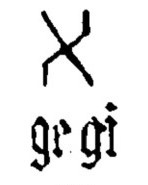
Almighty GIBOR: Understanding Guido von List’s G-Rune

Image
  This article has been writing itself in my head for the past couple of months. Its form continued to evolve until it fully formed during my sleep of 8 March. "These songs will be, to you, Loddfafnir, for a long time well-nigh unlearnable." Composed on 9 and 10 March 2024. ********* There is much misunderstanding and controversy over the 18 runes that Guido von List associated with the 18 Rúnatal verses of the Hávamál (verses 146-164). An internet search discovers the accusation that these runes, oftentimes, but inaccurately called “Armanen” runes are “pseudo-runes” or not runes at all. Some critics suggest that List simply “made them up.” While many are quick to condemn the authenticity of List’s entire Futhorkh, such complaints fail to comprehend the historicity and importance of List’s work. In fact, the first 16 runes of List’s system are what is today known as the Younger Futhork (which was in use throughout the Viking period from approximately the 8th through 12th c...

Understanding the Significance of List’s "Garma"

Image
I have tread a path which has led me to this very spot. Each step has brought me nearer and nearer to the very place where I now stand. While there was always choice, how could I do other than what I have done? The great wonder remains--have I tread this path before?  Written between 30 July and 6 August 2023. ********* Anyone who might choose to plumb the depths of the works of Guido von List (5 October 1848 – 17 May 1919), will discover several unfamiliar terms. Among these terms, coined by List, and used frequently throughout his works, is Garma . On the surface this strange word appears to be the equivalent of the Sanskrit-derived karma (“action”). Indeed, for List, there is a close etymological association between the words. Consistently, however, List chose to use Garma throughout his writings rather than karma . Stephen Flowers points out that List had no issue using the Sanskrit term Rita (“Cosmic Order”),[1] leaving readers perplexed as to why List seemingly coined his ...

A Portrait of Guido von List

Image
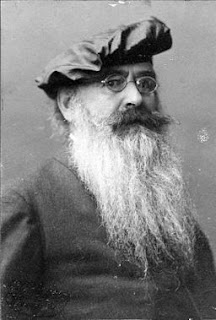
This short biography was written on 30 April 2023. It is intended as the first of a series of "portraits" of important figures in the twentieth century runic revival. It was written specifically for Knights of Runes and is included on their website. ********* Guido von List (5 October 1848 - 17 May 1919) was born in Vienna, Austria. Throughout his youth, List was an avid outdoorsman. He spent considerable time boating and mountaineering. He also dedicated himself to the study of history, archeology, and anthropology. His thoughts on a wide range of subjects were recorded in numerous articles.[1]The youthful List was already demonstrating his interest in the mystical world. He later described an episode that occurred when he was only fourteen years old: “After much asking, [I] received permission from my father to accompany him and his party who were planning to visit the catacombs [beneath St. Stephen’s Cathedral in Vienna] which were at that time still in their original cond...

Wihinei: List’s Secret Doctrine

Image
This short essay was composed on 8 July 2022. It represents my initial thoughts after reading Stephen E. Flowers' translation of Guido von List's, The Transition from Wuotanism to Christianity . List has long been maligned by his detractors for the  völkisch writings of his youth. It is important to acknowledge that his most influential works were all published when he was aged 60 years or greater. These range from his 1908, Das Geheimnis Der Runes (The Secret of the Runes) to his final unpublished work, Armanismus und Kabbala (Armandom and Kabbalah). It is certainly noteworthy that at age 63 he identified the Armanen as the keepers of an esoteric world-religion - Wihinei . ********* One of the key concepts that Guido von List (1848-1919) uses throughout his writings is that of “Wihinei.” The recent translation by Stephen Flowers of List’s 1911 work, Die Übergang von Wuotanismus zum Christentum ( The Transition from Wuotanism to Christianity [1]) goes a long way in clarify...